Research · MonARCH
The Payload Interface Board
What is MonARCH?
MonARCH is a collaborative project between the Electric Propulsion Lab (EPL) and the Laboratory for Advanced Space Systems at Illinois (LASSI). The mission features a multi-mode propulsion system that utilizes a novel mono-propellant. This design aims to demonstrate efficient propulsion in a compact form factor to support future small satellite applications.
Project overview
The payload interface board (PIB) is used for control and instrumentation of the onboard payload of MonARCH. The PIB acts as the primary communication and control bridge between the spacecraft bus and the MonARCH payload.
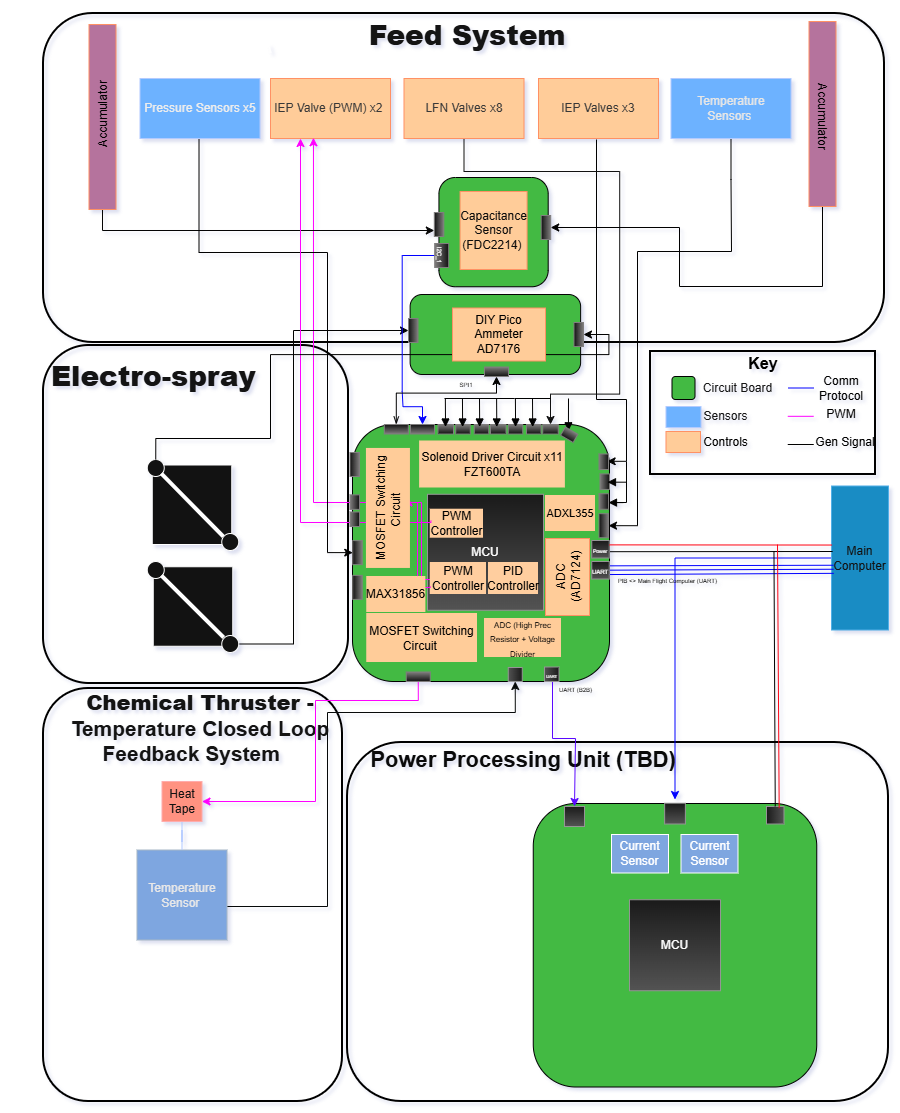
The four layer board design consists of many ICs for reading from a variety of sensors such as K-type thermocouples, 4-20mA pressure transducers, capacitance sensors, and an accelerometer. On the control side the PIB is required to interface with the electrospray and chemical propulsion systems, including chemical thruster ignition through heat tape actuation, solenoid valve control within the feed system, and PPU control. Additional functionality includes communication with the onboard flight computer (OBC); constant monitoring of pressure and temperature sensors, electrospray plume detection, payload current measurements, and catalyst level sensing. A good portion of the data and sequencing algorithms required for the research on MonARCH is gathered and executed by the PIB. Thus, the software of the PIB needs to be able to sample, arrange, and send data packets for the OBC to read. From an OBC perspective, both autonomous commanding such as a fill accumulator sequence and manual commanding such as open valve 1 is required for redundant layered protection. Some required commands include data polling from sensors, PPU on/off 3kV control, and run thruster sequences. The PIB is a peripheral to the OBC and it waits for specific commands. In case of emergencies, the PIB is required to continuously listen for UART commands to be able to halt or execute a different task at any moment. Lastly, the system needs autonomous error handling such as in the event where the OBC doesn’t catch a data outlier the system automatically moves into a safe state and communicates the error.
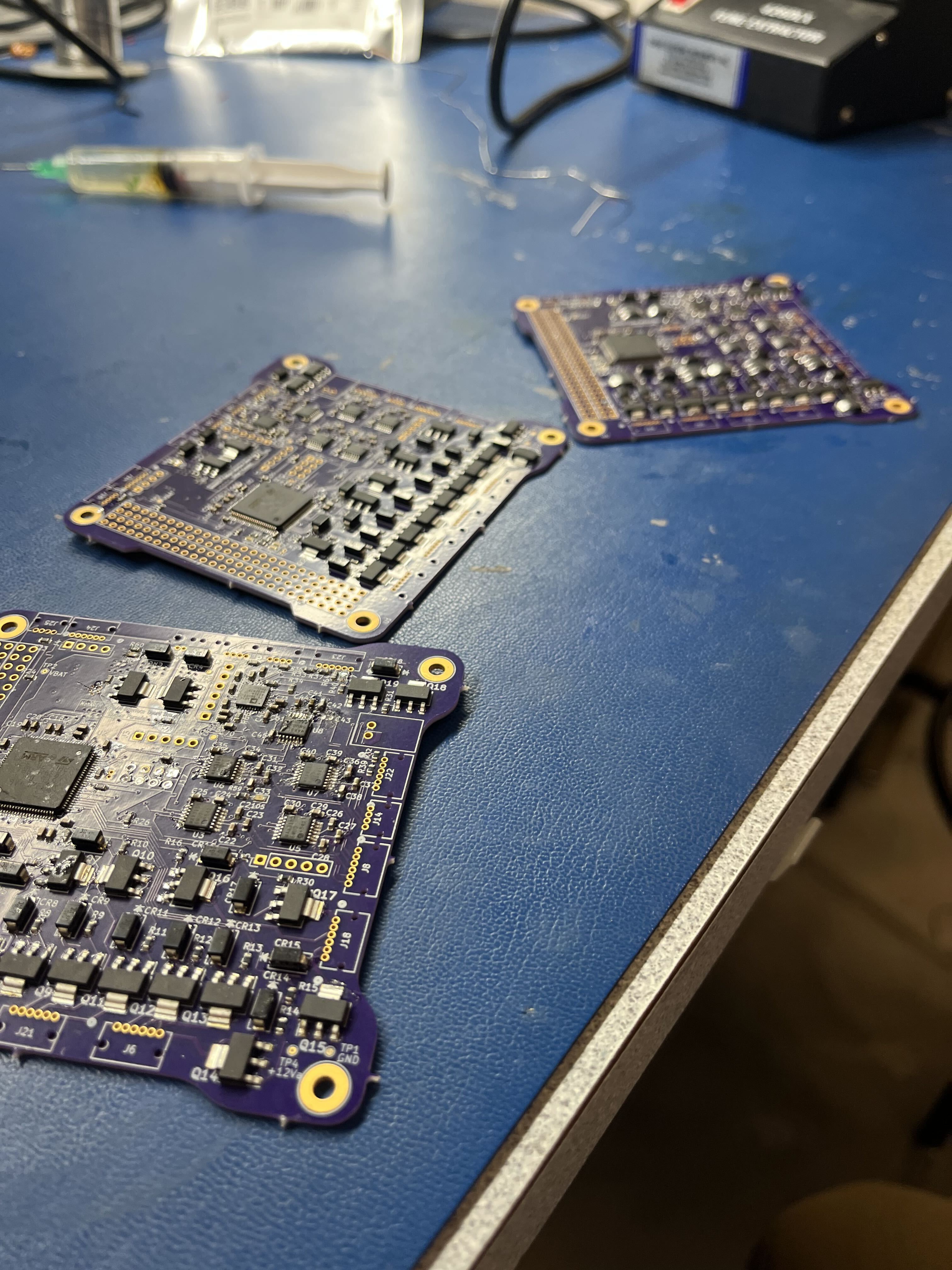
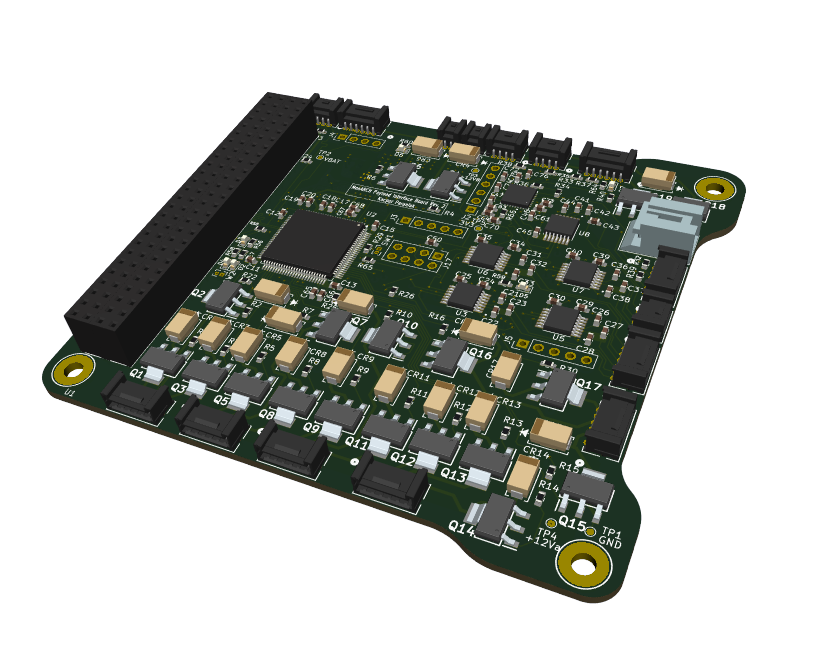
The Payload Interface Board
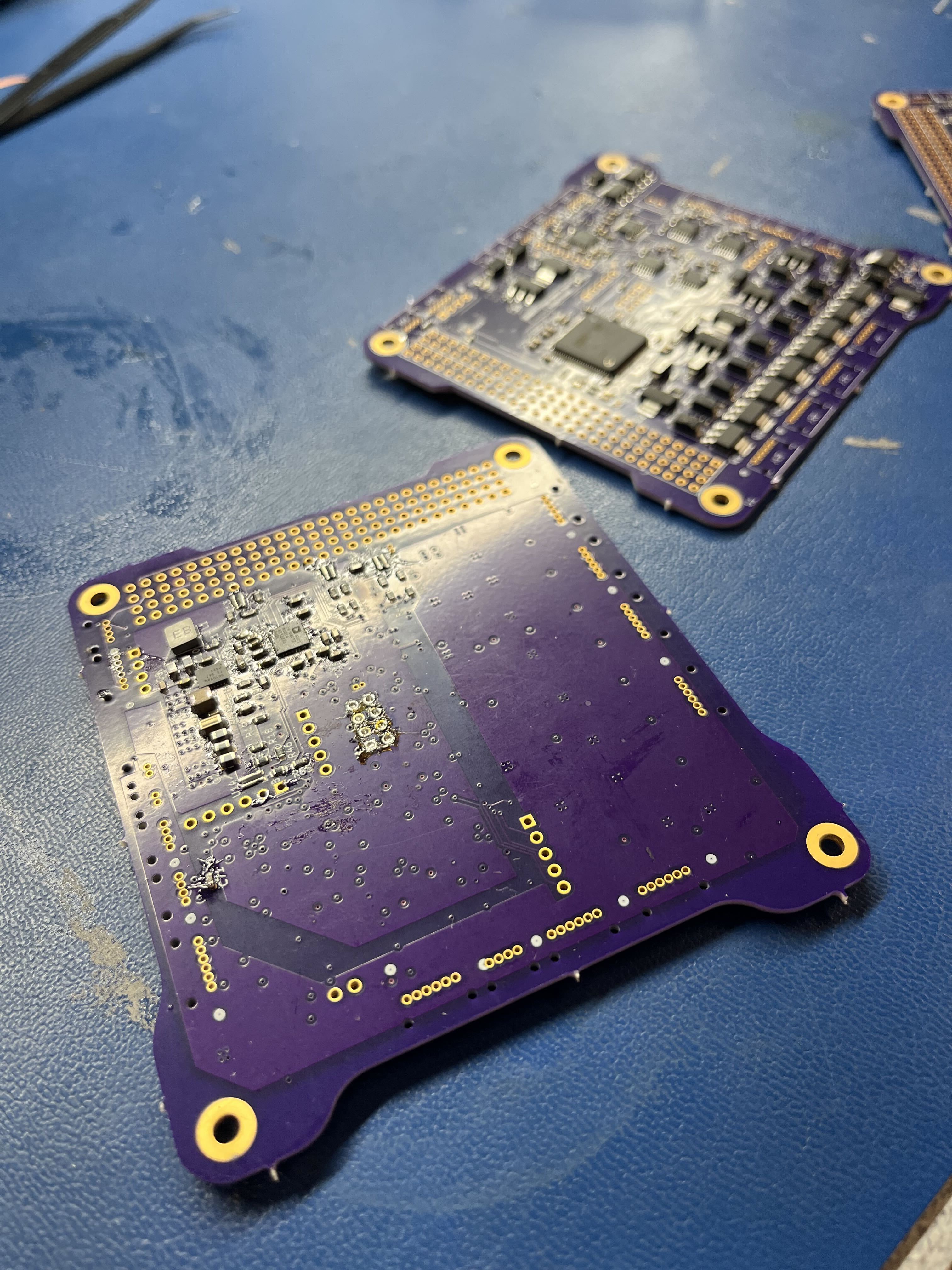
Back of PIB
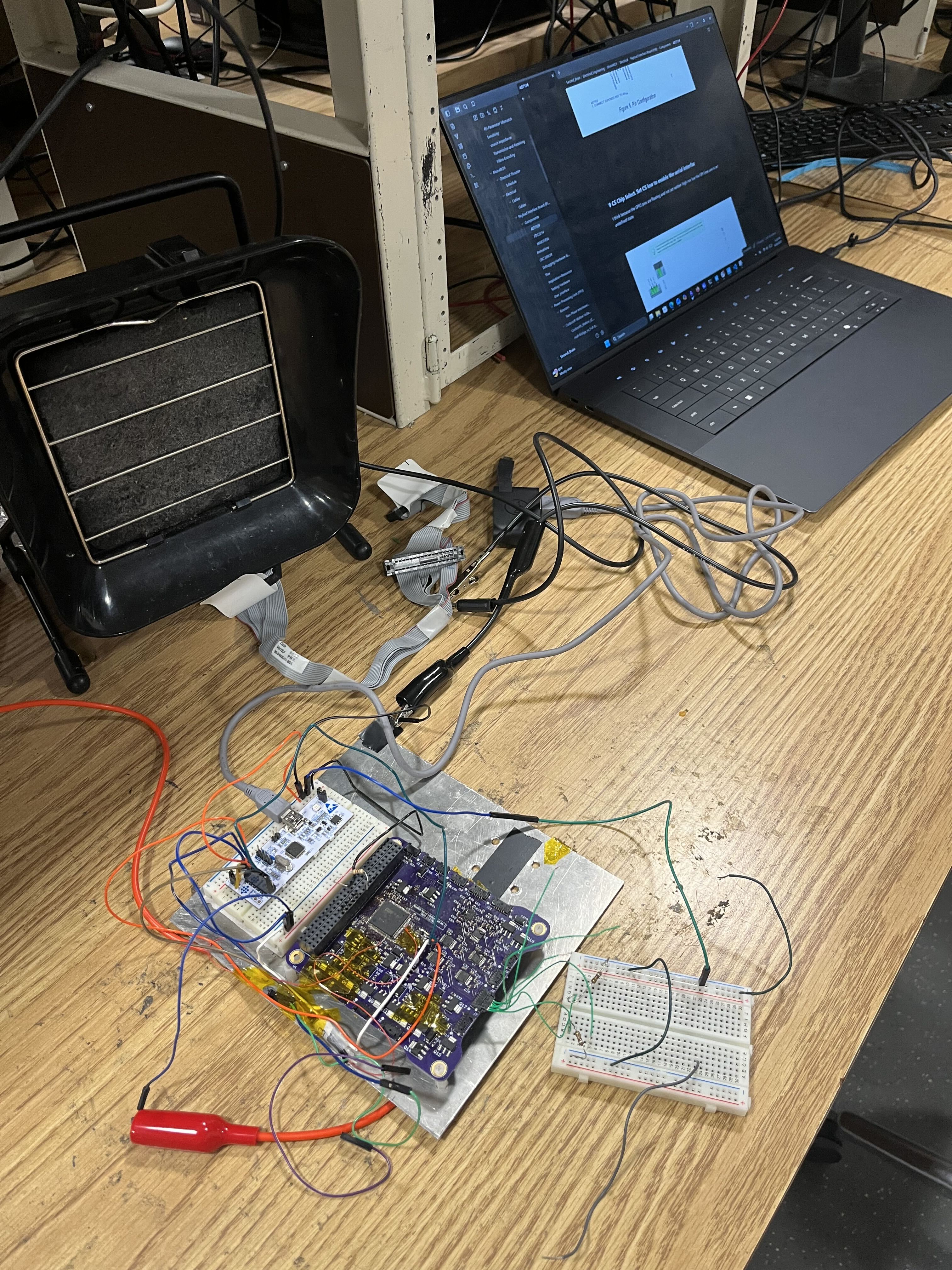
Debugging
Design & Build
Choosing Components
Once requirements were understood a functional block diagram was created to identify subsystem interactions and determine required voltage rails, communication protocols, and required functions throughout the payload and bus of MonARCH. Environmental analyzes were performed on the STM32 series to evaluate the radiation effects on the STM32 micro-controller unit using credible resources. Electronics were selected based on reliability, availability,operating temperature range, and existing aerospace usage. Components from STMicroelectronics, Texas Instruments, and Analog Devices were used due to their established reputation and broad availability within the COTS market. More information on how each specific component was chosen is in the research paper linked at the very bottom.
Design Phase
In the design phase, PCB schematics and layouts were developed using KiCad. The process included schematic capture, footprint verification, PCB routing, computing passive electronic values, design rule checking, and ensuring equal length of communication traces. Firmware for the PIBs was developed in STM32CubeIDE using embedded C. Initial firmware functionality included GPIO control for solenoid valve drivers; integrating, and building IC drivers for electronic chips on the PIBs. Lastly, a bill of materials (BOMS) was created to order, assemble, and build prototype PIBs in the final weeks of the Spring 2026 semester in collaboration with LASSI.
Testing & Debugging
Initital testing showcased many flaws in the first revision of the PIB. Testing began with the primary MCU (STM32L4A6) failing basic code execution, such as a simple GPIO LED toggle. Extensive continuity checks, pin probing, and datasheet analysis revealed errors in PCB design causing memory placement errors and constant board resets that prohibited code execution. These flaws were fixable with fragile "bodged" wire connections and thus testing resumed to IC drivers. However, these modifications severely hindered debugging, as loose and intermittent connections introduced noise and bit errors that frequently caused ST-LINK communication failures. After extensive hand-soldering and significant debugging time, the decision was made to develop a new PIB revision. Though the board ultimately succumbed to hardware issues, achieving brief solenoid control and successfully reading device IDs provided the critical baseline knowledge required for the next PIB revision.
With all mistakes documented the hardware redesign was simple and quick. The new revision was built and software drivers were corrected. As a result, temperature, pressure, voltage, and capacitance measurements were all successfully read from sensors. Additionally, a command line interface was implemented for easy commanding. This enabled easy solenoid valve control and will be used for integrating all MonARCH components together, testing feed systems, and propulsion elements in the fall semester
Command Line Interface
------------- COMING SOON ------------Main Flight Software
------------- COMING SOON ------------Challenges
The main challenges I encountered were designing a system around the space environment using COTS components, and developing compatible drivers for the STM32CubeIDE Hardware Abstraction Library (HAL) library.
MCU Selection
The entire 2026 spring semester I researched how the space environment affects electronics and realized that there were major issues to address, many of which made it difficult to subsequently make design choices. Such as picking out the microcontroller unit (MCU) which involved investigating the trade study between a COTS MCU and a rad-hard mcu. The micro-controller unit (MCU) is the most critical component of the payload interface system and is vulnerable to the space environment. A single event effect could cause mission failure if not taken into consideration during the design process, therefore, MCU selection required careful evaluation. The tradeoff between the risks posed by radiation exposure and the increased cost of radiation-hardened MCUs was the most important consideration. There are lots of commercial off the shelf (COTS) components available on the market that are not inherently designed for space flight nonetheless designed for radiation tolerance. Thus, the driving factors of selecting an MCU from the ST-Microelectronics (STM) series was the documentation behind these MCUs surviving and thriving in the LEO environment. Not only, STMs are very powerful, reliable, and accurate MCUs that we evaluated can perform every task the payload interface system needs to accomplish. Through rigorous research, the STM32L4A6 was chosen for the electrical payload system. The MCU consists of four I2Cs, three SPIs, three USARTs, and two UARTs which are essential communication protocols for interfacing with sensors, OBC, and PPU. The STM32L4A6 is an ultra-low-power processor and thus consumes exponentially less power than an STM32H7 series. The STM32L4A6 typically consumes an average of 20mA with a maximum of 150mA. It is a great processor when power consumption is a concern. Also, it is important to note this MCU has an explicitly defined low power UART which is needed to communicate with the OBC. There are two 16-bit PWM timers which are needed for IEP valve pressure regulation. For power, LASSI has allocated 1 watt for the entire payload interface system. H7s consume around 264 µ/MHz typical value at VDD = 3.3 V and 25 °C in Run mode (peripherals off) almost 3x the amount compared to the L4s which have around a power consumption of 91 µA/MHz run mode (LDO mode). A more through explanaton and validation of the STM32L4A6 is offered in the research paper linked below.
Developing Drivers for STM32 HAL
Every IC had a unique process for integrating its associated driver and bringing it to a functional state. This process differed significantly from high-level Arduino libraries I was accustomed to, which abstracted much of the underlying communication and data handling between ICs. For example, when communicating over I2C, the device address needed to be shifted left by one bit, with the least significant bit indicating a read or write operation. To develop reliable and functional drivers, I used preliminary skeletal drivers as references and adapted their structure to create my own custom drivers or implementations. For the FDC2214, I used an existing Arduino C++ library and converted its functionality into C-based functions compatible with the STM32 HAL. Additionally, I used device datasheets to develop error-detection functions, ensuring that each status and error bit was properly identified and interpreted.
Reflection
Working for the Electric Propulsion Lab on project MonARCH has been a revolutionary experience that I cannot be grateful enough for. From designing a PIB to helping build and operate electrosprays in the lab, my work has allowed me to apply and expand my knowledge across aerospace, computer engineering, physics, and beyond. I have gained hands-on experience with chemical safety while working with FAM142 propellant, as well as the safety protocols required when working with high and low pressures. Most importantly, MonARCH has strengthened my engineering problem solving skills by exposing me to new challenges on a daily basis and requiring me to diagnose, debug, and develop solutions with the team daily. Overall, my experience with MonARCH has deepened my understanding of aerospace systems while demonstrating my ability in debugging and problem solving issues in the field of embedded systems.
The Paper
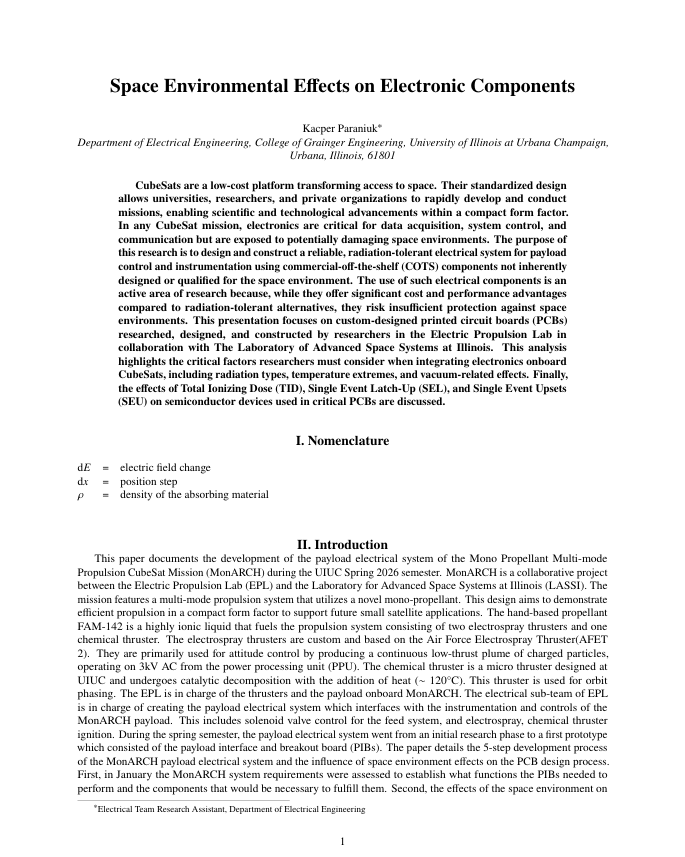
This Research Paper outlines the Space Enviornmental Effects on Electronic Components and details the development process of the payload interface board.
Download PDF →Symposium Posters
Space Enviornmental Effects on Electronic Components
Presented at 2026 Spring Undergraduate Research Symposium - April, 2026.
Open full PDF →Development of MonARCH Payload
Presented at UROP Summer 2026 Research Symposium - July, 2026.
Open full PDF →